


I-405
I-405
InTransit Extra

Optimizing transit performance through data-driven journey mapping

How customer experience insights and operational data support reliability, safety and ease of use across transit systems

By Vince Tam | HNTB

Transit agencies are seeking opportunities to grow ridership, maximize investments and ensure continued operational efficiency. Achieving these goals depends on a clear understanding of how riders experience the system across the full journey — from planning and service delivery to technology and communications.

Data-driven journey mapping integrates qualitative rider feedback with operational, fare and digital data, translating complex system information into actionable insights that can enhance performance and customer experience. In doing so, agencies can see where experiences vary by rider, mode or context and identify targeted opportunities to make investments in reliability, safety and ease of use.

How data-driven journey mapping improves customer experience

Data-driven journey mapping provides transit agencies with a clearer, rider-centered view of system performance. This approach can provide the following benefits:

  • A systemwide view of performance at the rider level: By visualizing the full passenger journey end to end, agencies can gain a shared understanding of how planning, operations, technology and communications intersect from the rider’s perspective. This information helps agencies align teams around what matters most to riders.
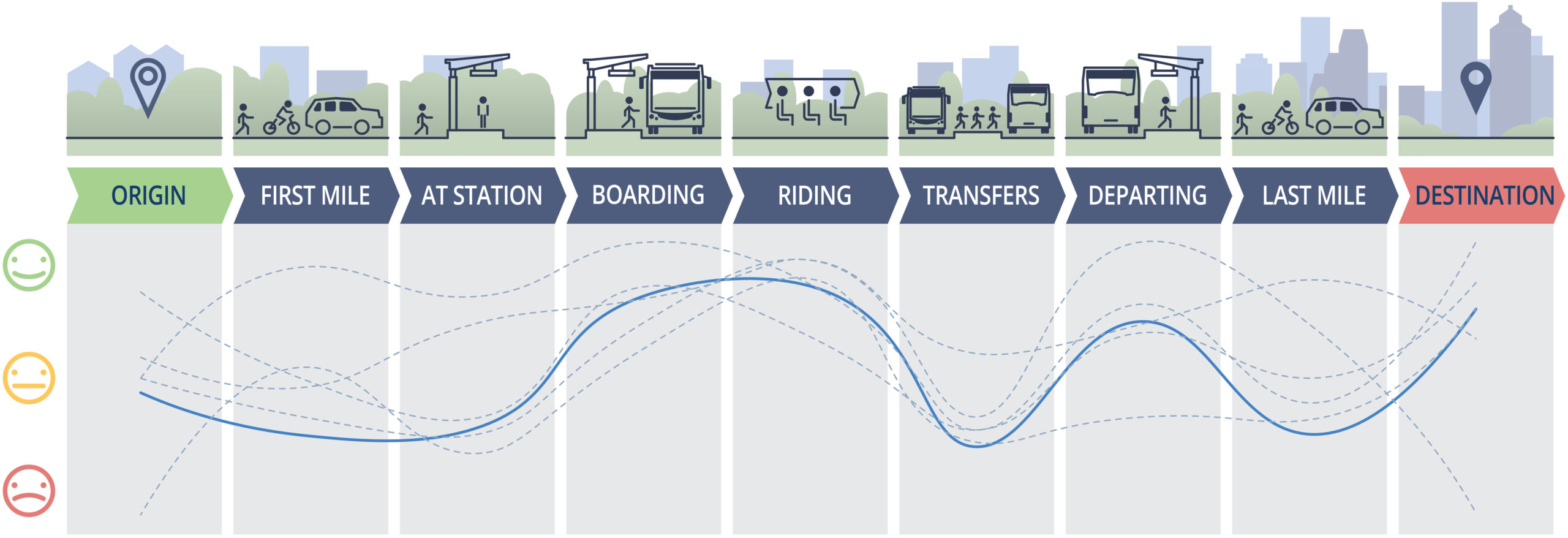
  • Clearer insight into where targeted improvements have the greatest impact: Journey mapping shows how the rider experience differs by mode or location. This clarity helps agencies focus improvements on the high-impact opportunities that matter most to riders.
  • A stronger foundation for investment and prioritization decisions: Journey mapping connects customer experience outcomes to capital and operational priorities by illustrating where investments are most likely to improve rider perception and system usability. Over time, this approach functions as a practical decision-support tool, informing resource allocation, sequence of improvements and communication of priorities to leadership and stakeholders.
Illustrated transit customer experience journey mapping graphic showing the end-to-end rider journey from origin to destination. Stages include first mile, at station, boarding, riding, transfers, departing, and last mile. Icons represent walking, biking, vehicles, stations, and buses or trains, while curved lines visualize variations in customer experience across the transit journey, highlighting moments of satisfaction and friction.

A journey map shows how customers experience varies by mode or location.

Translating journey mapping insights into action

Data-driven journey mapping delivers the greatest value when it is thoughtfully applied across planning, operations and investment decisions. Here is how agencies can translate journey mapping from insights into actionable outcomes.

  • Anchor journey mapping to clear agency priorities: Journey mapping is most effective when it is scoped around specific agency objectives, such as ridership recovery, safety, reliability or accessibility. Defining what the agency is seeking to understand helps ensure that insights translate into focused improvements and inform decisions that matter at both the operational and leadership levels.
  • Build on existing data and digital infrastructure: Many agencies already collect extensive data through fare systems, customer accounts, trip-planning apps and operations. Using these datasets as the foundation for journey mapping accelerates implementation, reduces duplication and allows agencies to move more quickly from data collection to insight while maximizing the value of prior digital investments.
  • Integrate journey mapping into decision-making processes: Journey mapping creates the greatest value when insights are shared across departments and applied to planning, capital prioritization and operational discussions. Treating journey mapping as an ongoing capability — rather than a one-time exercise — establishes a repeatable framework that guides investment decisions, supports coordination and tracks how changes influence rider experience over time.

Tools and methods that support data-driven journey mapping

Capturing the full rider journey requires both quantitative and qualitative datasets. By combining data collection tools that reflect system performance and rider experience, agencies can develop a more complete and reliable understanding of how the system functions from the rider’s perspective.

  • Surveys and digital feedback platforms: Used to quantify rider experience at key touchpoints and track changes over time.
  • Station intercepts and in-person outreach: Applied at specific locations or times to gather real-time, contextual insight into how conditions such as crowding, wayfinding and information availability affect the rider experience.
  • Rider shadowing and ethnographic journey diaries: Used selectively to observe end-to-end trips and uncover nuanced barriers related to accessibility, comfort or trip complexity that may not surface through structured feedback alone.
  • Fare, account and trip-planning data: Analyzed to establish rider profiles and travel patterns that add context to experience feedback and support segmentation by mode, frequency, time of day or trip purpose.
  • Operational and service performance data: Integrated to ground rider perceptions in objective measures such as reliability, dwell time and service frequency, helping identify where experience and performance diverge.
YouTube
Play

In her most recent role as the Customer Experience Lead for Dallas Area Rapid Transit’s system modernization program, DART Transform, Vince and her team are closely collaborating with the transit agency to improve riders’ day-to-day experience.

Video Feature
Choice Lanes Visualization
Explore conceptual renderings that illustrate how the I-24 Southeast Choice Lanes are enhancing mobility and safety for travelers in Tennessee.
PlayPlay

All renderings shown are for illustration purposes only.

Building a stronger foundation for rider-centered decisions

As transit agencies work to grow ridership, maximize investments and operate more efficiently, understanding the rider journey is increasingly essential. Data-driven journey mapping connects operational performance with rider experience, helping agencies translate existing data into insight that reflects how the system functions in practice.

Over time, this approach supports clearer prioritization, stronger coordination across teams and more informed decision-making. By providing a consistent view of how changes influence the rider experience, journey mapping helps agencies focus resources where they can deliver the greatest value.

ABOUT THE AUTHOR

Vince Tam, AIA, AICP
Urban Design and Planning Manager
HNTB Corporation

Vince Tam, AIA, AICP, is associate vice president and urban design and planning manager at HNTB, where she leads design-oriented planning for complex transportation and mixed-use projects. A licensed architect and certified planner, Vince brings more than 15 years of experience in enhancing customer experience and urban systems, including work modernizing transit services with a data-driven lens.

[email protected]