
THINK | 2026
Rising higher: Modernizing Chicago's airports
Already home to the world's busiest airfield and aviation's busiest square mile, Chicago is investing billions to modernize its airport system to serve ever-increasing demand for safe, seamless air travel.
By Michael McMurray, Commissioner | Chicago Department of Aviation
The aviation industry is entering a period of significant transformation. Passenger demand continues to grow, technology is reshaping how airports operate, and travelers increasingly expect a seamless, efficient and accessible experience from curb to gate.
Chicago’s airport system is building upon decades of innovation and accomplishment to meet this moment and achieve a new level of performance and customer service. Our system comprises of O’Hare International Airport (ORD) and Midway International Airport (MDW), two distinct airports that operate as a symbiotic system and served more than 100 million passengers in 2025.
Last year, O’Hare reclaimed its title as the busiest airfield in the world, with more than 860,000 landings and takeoffs. That translates to approximately one arrival or departure every 37 seconds. O’Hare is the only U.S. airport with hubs for two major airline carriers, United and American. This is fantastic for the travelers, who can connect virtually anywhere in the world through our system.
As far as the Chicago Department of Aviation (CDA) has advanced, this remains an opportune time to invest in airport modernization. Looking to the future, the aviation industry can expect higher numbers of air travelers, greater calls for efficiency, sustainability and safety, and ever-rising expectations for superb travel experiences – within and beyond the airport ecosystem. CDA intends to be a world leader in meeting these challenges and is in a strong position to modernize facilities across the system.
Generational investment at ORD
O’Hare is the largest of the two airports and stands as a global pacesetter.
To accommodate this immense volume of passengers, CDA is embarking on ORDNext, a multi-year, $8.78 billion program that will deliver 14% more gate capacity, provide greater flexibility for our airline carrier hubs, enhance operational efficiency, elevate the passenger experience and ease flight connections for decades to come. It features an array of infrastructure projects:
- Concourse D: A new, $1.455 billion, 590,000-square-foot satellite concourse, which broke ground in 2025, and which is scheduled for completion in late 2028. It will feature 19 new gates, expanded passenger amenities and infrastructure to support long-term growth. Importantly, 18 of the new gates will feature multiple aircraft ramp system (MARS) technology. This allows one large, wide-body aircraft to park, or alternatively, two smaller, narrow-body aircraft to park side-by-side, in the exact same footprint. Such flexibility will smooth passenger connections between international and domestic flights.
- Concourse E: Another new concourse, about 460,000 square feet, is planned for construction west of Concourse D. Concourse E will further expand domestic gate capacity for passengers.
- The Global Terminal: This massive 2.2 million-square-foot terminal will unify passenger processing for international flights, enabling more seamless arrivals, departures and connections.
- Underground Tunnel System: A new tunnel will connect the new terminals and concourses, and will feature advanced baggage handling, secure walkways and an automated people mover.
Together, these investments represent a more flexible, connected and efficient airport environment — one that can support changing airline needs, improve passenger movement and strengthen Chicago’s position as one of the world’s most important aviation gateways.
Midway’s modernization
While ORDNext is helping shape O’Hare’s next chapter, Midway International Airport shows how modernization can strengthen performance within a highly active, compact airport environment. Often referred to as the “busiest square mile in all of aviation,” Midway is serviced by six airlines, with Southwest Airlines making its home there. The airport serves more than 80 destinations and employs about 8,000 people.
The airport completed its own modernization program, a multifaceted program including the rehabilitation of Runway 13 Left/31 Right, one of four active runways that handle a high volume of air traffic. The program also modernized three core areas of Midway’s terminal operations: expanding its security checkpoint, enhancing the terminal garage and completely recreating its concession program, which is truly something to behold.
The recently renovated Midway Central Market is the airport’s dining and shopping hub. This 70,000-square-foot marketplace offers travelers a variety of local Chicago eateries, premium shops and a dedicated lounge.
Taken together, the work at O’Hare and Midway reflects a systemwide approach to modernization. Each airport has a distinct role, physical context and operating profile, but both are being advanced with the same goal: to create airport environments that are more efficient, more welcoming and better prepared for future demand.
Foundational elements to modernizing our system
CDA views three foundational elements as essential to delivering a robust and effective airport system.
Elevating the passenger experience: Today’s travelers want easy connections, navigable, accessible terminals, and a solid portfolio of dining, shopping and lounge options. It all has to work in concert, whether Chicago is someone’s destination, point of origination or they are connecting.
At ORD, connecting passengers make up more than half of all passengers served. ORDNext is increasing wayfinding signage and bolstering a frontline passenger assistance team. CDA has multilingual customer service personnel who assist passengers in the terminals and offer other accommodations to improve accessibility. For example, through our partnership with the Hidden Disabilities Sunflower Lanyard program, ORD provides additional support to travelers with autism, PTSD or hearing loss. Free visual interpreting services also are offered at ORD and MDW.
Lifted by a modern transportation ecosystem: The passenger experience also begins before someone enters the terminal and continues after they leave. Ground transportation connections to and from our airports are a critical part of the customer experience. Part of our modernization process involves engaging regional transportation partners as we advance our work, to ensure that adjacent systems are optimized to support rising demands.
CDA has long collaborated with state-level partners – the Illinois Tollway and Illinois Department of Transportation – regarding egress and ingress to our airports. In the near future, Illinois Tollway’s Elgin O’Hare Western Access program will be providing long-awaited connections with the western side of O’Hare. This is a $4 billion-plus infrastructure project, including all-electronic toll roads and new or improved interchanges. Meanwhile, to the east of O’Hare, the Illinois DOT has a massive modernization project for I-190 that will involve upgraded interchanges, reconfigured lanes and ramps and safety features.
CDA values its strong partnership with the Chicago Transit Authority, whose rapid transit service remains essential to our success. They provide Blue Line service to O’Hare and Orange Line service to Midway, the latter operating 24/7/365. Connections are also being made with Metra commuter rail to potentially increase runs to the station that serves O’Hare’s consolidated car rental facility and parking lots.
These improvements will relieve roadway congestion, improve travel reliability and ensure that our world-class airports are supported by seamless access.
Strong and sustainable funding: The Chicago Department of Aviation operates from a strong and sustainable funding model that does not rely on local or state tax dollars for operations or capital improvements at O’Hare or Midway.
A significant share of funding comes from airline partners. CDA works closely with these partners to evaluate proposed projects and align investments around improvements that will deliver the greatest value for airport operations, passengers and the broader aviation system.
Federal grants also support certain facility updates. Funding from federal partners, including the Transportation Security Administration and the Department of Homeland Security, helps advance improvements to security checkpoints, customs areas, baggage claim areas and queuing signage, allowing federal agencies to perform their duties more effectively within the airport environment.
In addition, CDA generates revenue through passenger facility charges, concessions, rental cars and fixed-base operators at both airports. Together, these revenue sources help offset operating costs for airline partners, supporting a more efficient financial structure that ultimately benefits the traveling public.
Onward, skyward
The value of airport modernization is measured not only by what it delivers inside the airport, but by what it makes possible beyond it.
CDA is moving these modernization initiatives forward at a crucial time in the history of aviation. As airports around the world prepare for rising demand, evolving customer expectations and the need for greater flexibility, Chicago is investing in an airport system built to serve the future. We look forward to working with and learning from other airport leaders and teams globally who are modernizing their facilities, strengthening their communities and preparing aviation for what comes next.
ABOUT THE AUTHOR
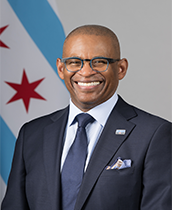
Michael McMurray
Commissioner
Chicago Department of Aviation
Michael McMurray is Commissioner of the Chicago Department of Aviation (CDA), one of the world’s largest aviation systems, serving more than 100 million passengers per year across O’Hare and Midway International Airports. Appointed by Chicago Mayor Brandon Johnson in 2025, Commissioner McMurray brings more than 25 years of experience, with a career-long focus on delivering complex infrastructure projects, expanding economic opportunity, and strengthening the systems that connect communities.
In his tenure as Commissioner, McMurray has overseen the groundbreaking on the new $1.455 billion Concourse D, the largest new facility to be constructed at O’Hare in more than 30 years and the first phase of the multi-year, $8.78 billion ORDNext capital program. He also oversaw the rehabilitation of Midway International Airport’s Runway 13L/31R and its associated taxiways.
Commissioner McMurray holds a bachelor’s degree from Northwestern University and a law degree from the University of Michigan Law School.